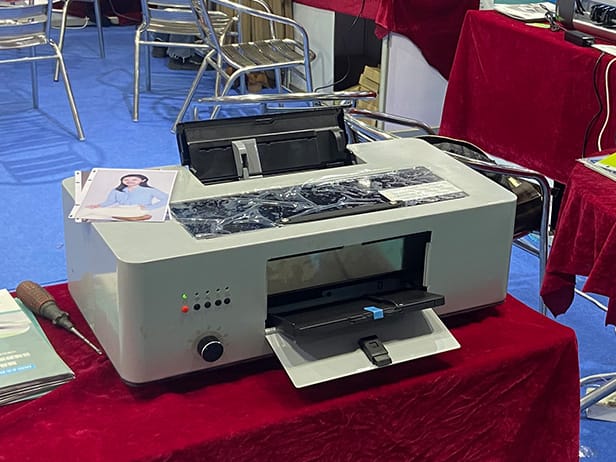
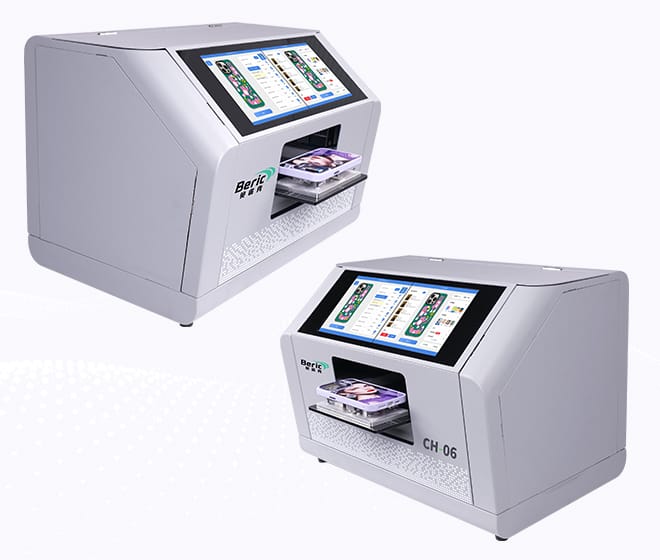
UV printing has become a popular solution for producing customized phone cases, allowing businesses to print full-color graphics, logos, photographs, text, and decorative patterns directly onto phone case surfaces. For a phone case printing business, the right UV printer needs to match the required case size, production volume, print quality, ink configuration, and workflow.
Choosing a printer based only on price or maximum resolution can lead to equipment that does not match the actual production requirements. The following factors are important when selecting a UV printer for phone case printing.
Printing Area and Phone Case Size
The printing area is one of the first specifications to check. Different phone models have different case dimensions, and a printer needs sufficient working area to accommodate the products being printed.
A compact UV printer can be suitable for small-format phone case production, while a larger flatbed UV printer provides more space for multiple cases or other customized products.
For businesses printing several phone cases in one operation, the usable printing area can directly affect production efficiency. The number of cases that can be positioned on the bed at the same time should therefore be considered together with the individual case dimensions.
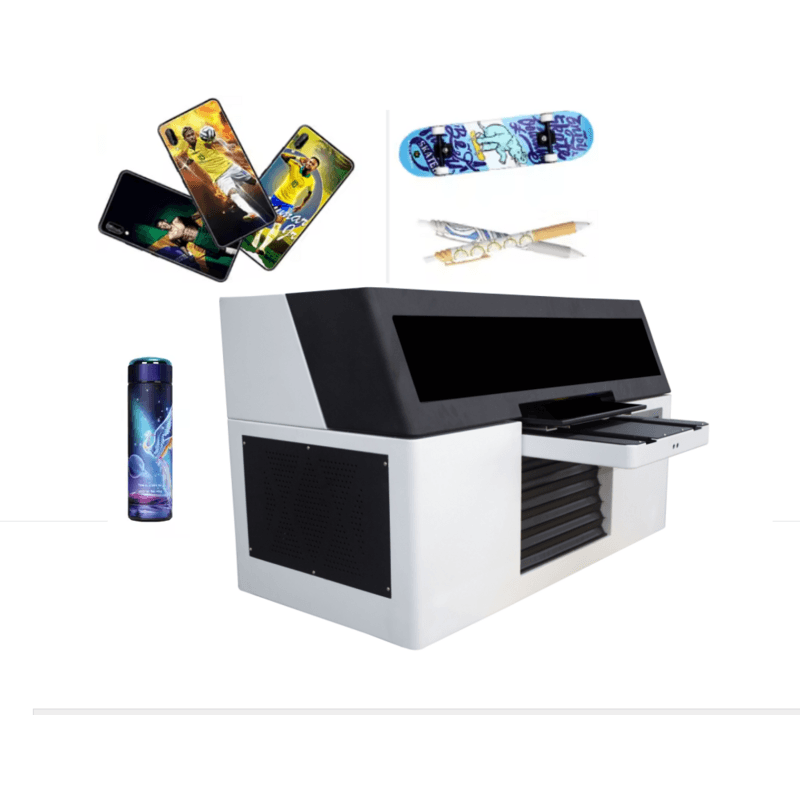
UV Printer Ink Configuration
CMYK ink is used to produce standard full-color phone case graphics. However, additional ink channels can provide greater flexibility for customized phone case printing.
- CMYK: Full-color image and graphic printing
- White Ink: Printing on dark surfaces and creating a white base layer
- Varnish: Gloss effects and selective surface decoration
A UV printer with CMYK, white, and varnish capabilities can support a wider range of phone case designs than a standard CMYK-only configuration.
White Ink for Dark and Transparent Phone Cases
White ink is particularly useful for phone case printing because phone cases are available in many different colors and surface types.
When printing a colorful design on a dark phone case, a white ink layer can be used beneath the CMYK colors to improve color visibility. White ink can also be used as part of layered printing on transparent cases.
Businesses offering customized phone cases should therefore consider whether white ink is required for their target product range.
Print Resolution and Image Detail
Phone case graphics can contain small text, detailed logos, photographs, and fine patterns. Print resolution and printhead performance can therefore affect the final appearance of the product.
Higher resolution can help reproduce fine details, but resolution should not be evaluated independently. Printhead technology, ink quality, printing speed, substrate condition, and RIP software also influence the final printing result.
For commercial phone case production, a suitable balance between image quality and production speed is generally more useful than selecting equipment based solely on the highest advertised resolution.
Phone Case Material Compatibility
Phone cases can be made from different materials, including acrylic, TPU, PC, PVC, silicone, leather, and other plastics or composite materials. Surface characteristics can vary significantly between products.
Before purchasing a UV printer, businesses should confirm that the ink system is suitable for the phone case materials they plan to print.
Sample testing is recommended when working with a new material or supplier. Testing can evaluate ink adhesion, color reproduction, surface finish, and resistance to normal handling.
Material Thickness and Printer Clearance
Phone cases are not completely flat products. Their edges, camera openings, raised areas, and different structural designs can affect the positioning of the product during printing.
The maximum printing height or material thickness supported by the printer should be checked against the actual phone case dimensions.
A suitable printing platform should also provide stable positioning so that the case remains correctly aligned during printing.

Printing Speed and Production Volume
The required production volume should be considered before selecting a UV printer. A printer designed for occasional customized orders may have different performance requirements from equipment used for continuous commercial production.
For small businesses, startups, and personalized product shops, a compact UV printer can provide sufficient production capacity while occupying less workspace. Higher-volume operations may require a larger printing area and faster production configuration.
When comparing printer speeds, it is useful to consider the actual production workflow rather than relying only on the maximum speed listed in the specifications.
RIP Software and Color Management
RIP software plays an important role in UV phone case printing. It controls image processing, color management, white ink layers, varnish effects, and printing parameters.
A suitable RIP workflow allows operators to prepare different phone case designs efficiently and adjust ink layers according to the substrate and artwork.
For businesses handling many customized orders, software usability can have a significant effect on daily production efficiency.
Flatbed Positioning and Product Fixtures
Accurate positioning is important when printing phone cases because the artwork needs to align with the usable surface of the case.
Fixtures or positioning templates can help maintain consistent placement when printing multiple cases. They can also make batch production easier when the same phone case model is printed repeatedly.
Businesses producing multiple phone case models should consider whether the printer supports flexible positioning and customized fixtures.
UV Curing System
UV curing determines how quickly the ink is cured after being deposited onto the phone case. LED UV curing systems are widely used in modern UV printers because they provide controlled curing during the printing process.
A stable curing system helps achieve consistent surface finish and ink performance. The curing configuration should be evaluated together with the ink formulation and the materials being printed.
Maintenance and Ink Management
Regular maintenance is necessary for stable UV printing performance. Printheads, ink systems, UV lamps, and other components require appropriate maintenance according to the equipment manufacturer’s recommendations.
For phone case printing businesses, an easy-to-maintain ink system can reduce production interruptions and make daily operation more manageable.
Before purchasing a printer, buyers should also check the availability of replacement printheads, ink, dampers, filters, and other consumable or service parts.
Sample Testing Before Purchase
Sample printing is an important part of selecting a UV printer for phone case production. The same printer may produce different results on different phone case materials and surface finishes.
Businesses can provide their actual phone cases and artwork for testing and evaluate:
- Color reproduction
- Small text and fine detail
- White ink coverage
- Varnish effects
- Ink adhesion
- Surface finish
- Printing consistency
This provides a more practical basis for equipment selection than comparing specifications alone.
Choosing the Right UV Printer for Phone Case Production
The appropriate UV printer depends on the business model and production requirements. A compact A5 or A4 UV printer can be suitable for small-format customized products and phone case printing, while a larger A3 or flatbed system can provide greater working space for multiple products and larger substrates.
Key specifications to compare include printing area, material thickness, ink configuration, printhead technology, printing speed, UV curing system, RIP software, and maintenance requirements.
For businesses focusing primarily on customized phone cases, a UV printer with CMYK + White + Varnish can provide greater flexibility for colorful graphics, dark cases, transparent cases, and decorative surface effects.
Beric UV printers include compact models designed for small-format customized printing and phone case applications. Contact Beric for printer specifications, sample testing, and equipment recommendations based on your phone case materials and production requirements.